|
I will endeavour in this personal, reflective piece not to repeat things that I have already written much about before. ‘Rise Up’ ~ Vincent Cavanagh © 2024 LISBON World Youth Day Week started on a Tuesday, 1 August 2023, which makes keeping track of events personally in one’s mind rather difficult. Later on, at times one could be forgiven for the honest mistake of losing, or even gaining, a day on your internal calendar. Opening the Week was the get-together, catch-up and sing-song of the Australia Gathering: an event more geared towards schoolies and schoolies-at-heart than for those seeking quiet, whilst I utterly failed to not be sunburnt a second time on pilgrimage. (Venice being the first.) The whole week, and events, and talks, of World Youth Day (WYD) is a marathon and not a sprint; and I was burning more energy and mental capacity than I was recovering in what little moments of quiet recharging there were to begin with. WYD is not what one would call ‘introvert-friendly’ by any personal measure. Nor is it amenable to diabetics or children of diabetic parents—especially when there is no clear idea of when the day’s Mass was to actually start for a person to be able to figure out whether they were inside or outside of the one-hour fast before Mass and be able to act accordingly. Personally, it is very hard—almost impossible—to keep up with others when you are emotionally and physically exhausted before mid-day and your strongest, inmost desire is to just go somewhere far away from the thronging crowds and just huddle down in peace, quiet, and shade to recover. Missing breakfast on the second day because of such exhaustions the previous day is also not a recipe for congenial interactions with others, peer-to-peer or otherwise. Mea culpa. ALSO, it is suffocating to one’s already stressed psyche when self-autonomy is curtailed (e.g. “You can not under any circumstances go to events or places by yourself.”) when all you want to do is go straight back to the hotel and get out of the heat because you are already overloaded but your group has decided to look inside churches on the way, instead. Please be under no illusion, I do appreciate the need to keep people together for everyone’s personal safety and security (and insurance protocols…). But surely there must some better way to balance keeping track of everyone and an individual’s internal idea of safety being to get out of the crowds and temperatures that they are struggling amongst? Communication to normal (i.e., non-group leading) pilgrims was, at times, let down by conflicting or insufficient streams of information about what the day’s schedules were or what was, or was not, permitted by the Pilgrim Leadership, which left those pilgrims who do not always live their lives by the seat of their pants (far from it) at a disadvantage as to knowing what they needed to plan or prepare for ahead of time. Conscientious planners and World Youth Days do not mix well. THE good of WYD Week was indoors and away from the hot sun on the Friday, Day 4, for the third Catechesis session with the Bishop of Dallas, Texas, Edward ‘Ed’ Burns speaking on the topic of Mercy, God’s loving mercy. From my experience of living this WYD, this was the mountain top—the church where this session was held is literally built on a hill—before going through Calvary, which for me was the whole weekend of the WYD Vigil. Waiting under the Iberian sun. (Photo: Vincent Cavanagh © 2023) STAKING out plots of turf in the Iberian sun at the WYD Vigil site for the rest of the Diocesan pilgrims with the Advance Team, was an opportunity offered to me. I accepted it, glad to have not placed myself in a position where I would’ve been far more likely to have blown my top at someone due to the overarching heat of the day, namely the long Pilgrim Walk from Lisbon centre to the Vigil site on the banks of the Tejo (Tagus) River. Prior to Pope Francis arriving and the Vigil starting, there were all sorts of talks, testimonies and musical interludes. The one that stuck in my craw most was everyone being asked questions by representatives of an International Youth body that was the ‘fruit of’ the 2018 Youth Synod, questions that were specifically prompting ‘Yes’ answers from listeners in a call and response method, without really giving anyone time to reflect upon the questions and give real, honest answers. Rigged “questionnaires” that have only one option are not honest nor something one should expect to see in the Catholic Church let alone WYD. Being hemmed in and surrounded, virtually on all sides, by all the other pilgrims around me at the Vigil site and the near constant music—which I wished to God would have stopped—gave me sensory overload which put my body into adrenaline-fueled survival-mode for the rest of the weekend. I only really started calming down internally when we were in Fátima on our post-WYD ‘retreat’. As it was, taking photographs was the only thing that I had any control over and so used that as a way of distracting myself from the discomforts that I had chosen (many months ago) to be in that night. Pope Francis’ motorcade entered the Vigil site at around 8:30 pm. Once on the Vigil stage the Pope listened to two testimonies: one from a local Portuguese priest and the other from a young woman from northern Mozambique who had survived an attack by Islamist insurgents on her village. (In all honesty I had forgotten that either of these testimonies had happened and only really recalled them when I was looking up online reports about the Vigil to jog my memory for this piece.) What little I do remember of Francis’ Vigil Address to the youth was the on-the-fly translation by the volunteer English interpreter over our group’s portable radio/speaker: ‘Joy is Missionary’ ‘…become roots of Joy’ ‘You don’t find joy closed up in a library’ ‘…we have to find a key for it.’ — ‘Have you gotten tired? …when you feel like a wet sponge…?’ which got a round of laughs from the Pope’s imitation of a lethargic, wet sponge. ‘…when you see a friend fallen down, pick them up. Powerfully pick them up!’ ‘…the only time we look down on someone is when we are helping them up again!’ WYD 2023 Rise Up drone display. (Photo: Vincent Cavanagh © 2023) AFTER the Address there was a drone light show displaying the 2023 WYD Theme “Rise Up” in multiple languages before we went into Adoration of Our Blessed Lord in the Eucharist. The assembled symphony and choir were a true highlight, giving it their all. Then came the blessed (in both ways) silence in the moment of pause during Adoration where one could’ve heard a pin drop echo throughout the whole Vigil site, across the river beside us, and beyond. The only upset to all of this was kneeling down on the aggregate that the site was built atop. What amount of grass that had been put down had been all but burnt by the Iberian sun over the course of the WYD Week leaving only the odd tuft of hardy grass root and a plethora of bits of rock ranging from golf ball to house brick-size. After all of the miles it had been flown and transported across Italy, the sleeping bag I had bought specifically for the Vigil ended up being used as little more than padding for both my knees and posterior. (As I write this, it still remains unopened from the day it was bought at the camping warehouse.) Following Pope Francis’ farewell to the crowd there was post-Adoration music from about 10:30 pm led by one Padre (Father) Duarte Rosado and his guitar. The music finished at 11:43 pm at which time we were then audibly water-boarded until 1:06 am(!) by an ecological propaganda film flying under the guise of Laudato Si’. Because it was in English there was no escape for any of us English-speakers who are already quite sick to death of this sort of emotional blackmailing that we have already experienced ad nauseam back home in our respective countries. I didn’t need more kindling for my already overworked emotional barometer. I wanted—wished for silence, for the blazing glare of a thousand suns of the Vigil site floodlights to be switched off (keeping only the necessary ones over the main thoroughfares between sectors turned on), for all of the music to stop, for sleep—to not be alone in a sea of people, even amongst those that I had walked through Italy with. It’s alienating to be stuck sitting on a still rolled-up sleeping bag inside of an almost 2-foot-square patch of ground surround by an array of bodies all packed in like a human game of Tetris, all of them appearing to be sleeping despite the adverse conditions. I tried sleeping, but I couldn’t. The mid-night air was so cold that it numbed me to my very bones. Admittedly it was nowhere near as freezing as I remember it having been in Randwick for Sydney WYD 2008—nothing compares to how cold a night that was. So I ended up walking back and forth from the sector our Diocese had been placed in (A5) to the banks of plywood toilet cubicles two sectors over for what felt like a dozen round trips throughout the rest of the night, in-between tip-toeing through sleeping pilgrims to get to the water station to refill my water bottle and trying not to turn into a human icicle whilst sitting huddled down on the ground. During the course of that night a veteran pilgrim gave me an un-used space blanket of theirs to keep warm under and we later ended up doing Night Prayer and reading the approaching morning’s Gospel Readings for the Mass whilst walking between our sector and the toilets. ‘Tejo River Sunrise (version 2)’ ~ Vincent Cavanagh © 2024 In spite of my intention not to do so, I ended up seeing dawn break over the Tejo River in real time during a solo return journey from the toilets. My attempts at trying to eat breakfast were mostly scuppered by my stomach, still in survival-mode, being more clenched than a duck’s behind and leaving me wishing that I’d eaten more of the Pilgrim Vigil Provisions the night before. Then as the sun was fully emerged from below the horizon line the “wake-up” call was sounded across the assembled mass of pilgrims at 6:30 am in the form of classical and “doof-doof” music remixing by the DJ Padre himself (whom I had never heard of before Lisbon WYD), Fr Guilherme Peixoto. Fr Guilherme Peixoto working the mixers. (Photo: Vincent Cavanagh © 2023) Pope Francis arrived soon after 8 am, greeting the crowds of pilgrims from the open-top Mercedes G-class Popemobile (no, I am not a petrol-head, I just like being thorough) before being whisked behind the stage to prepare for the World Youth Day Mass on the Feast of the Transfiguration of the Lord Jesus. I did have to force myself through a barricade of WYD volunteers to get back into our sector from visiting the toilets the last time before Mass after the Portuguese police had told the organisers to lockdown the site for the Pope’s arrival. I was not alone in wanting to get out of the pathway and back into the sector. One of those organizational hiccups, I guess. What I mainly remember of the Mass is standing around in the rocky earth under the mid-morning to mid-day sun. If it hadn’t been for the heat and the previous night I might have laughed at the end of the Mass with how almost comical it was with the litany of “after-Mass announcements”, ranging from thank-yous to invitations to the 2025 Year of Jubilee in Rome and then—finally—what everyone (who wasn’t curial clergy) was waiting to hear: the announcement and reveal of Seoul as being the next host of WYD in 2027. And then came the cauldron of making and surviving our way in small, separate Diocesan pilgrim groups through the absolute crush of people to get out of the WYD Vigil site and head back to our hotel in Lisbon. Amongst the small group of pilgrims I was with, it was a non-stop trek through the local streets and boulevards to the (ahem) nearby Oriente Station and then forcing ourselves through the police-controlled scrum of people trying to get into the station itself to return to their own accommodations as well. I think that there was definitely a Grace of God upon us as we walked through those streets to the station without stopping but just continuing on and on, pushing away any form of exhaustion as we made towards our stated goal. Sightscreens at Marquês de Pombal Square the day after the WYD Closing Mass. (Photo: Vincent Cavanagh © 2023) Alighting from the Lisbon Metro we arrived at Marquês de Pombal Square—where we had gathered before to welcome Pope Francis to Lisbon and participated in the Stations of the Cross—and finally got both a foot and a seat inside the air-conditioned McDonald’s, where we had lunch and cooled down on soft-serve ice creams. What had once been a buzzing throng of international pilgrims outside was now a virtual ghost-town save for the workers continuing to take down the scaffolding for the Welcome Stage and all of the sightscreens dotted in and around Eduardo VII Park. Gathering ourselves, we made the short walk back to our hotel and to the awaiting welcoming committee of the Diocese before I took the elevator up to my room and crashed out cold on the bed—doing the one thing I later found out a person who has stayed up all night should never do—and then scrambling to catch-up with where all the other pilgrims from the Diocese were having dinner. As nice as it may be, never—and I mean NEVER—leave your phone on silent (or off) when people are trying to contact you with their plans, especially if they involve food. AND after all that happened in Lisbon—and maybe in spite of it—I still find that I want to go through it all over again. I must be mad. Of course, I think we (pilgrims) might already be mad for doing it in the first place, but my main motivation for embarking on such a crazed endeavour as to do it all again would be to prove that I could do it. Do it right the second time. Knowing (at least roughly) what I would be facing rather than having everything coming at me like a boxer’s fist in an arena with all of the lights turned off. To prove that I could do it without all of the angst and baggage (both metaphorical and physical) that I took with me to Lisbon. That I wouldn’t be going in blind, as the saying goes, the second time around. ‘Jerusalem Bay (2024)’ ~ Vincent Cavanagh © 2024 You may well call foul and decry that as selfishness, for whatever part of it is selfishness, but I have had the same experience of not wanting to let a “bad” experience get the better of me when I had walked the Jerusalem Bay Trail from Cowan to Brooklyn (Hawkesbury River) the first time. I walked it a second time with another group (who knew what they were doing and where they were going) and I got through it with far fewer trials and tribulations than I had the first time around. I want to prove—if only to myself—that I can have a “good” WYD experience and not be left with thoughts such as “yes, I did it, but if I’d done this or that instead”, as I have been when going over my memories of Lisbon. THIS whole WYD journey started with me reading a notice in a parish bulletin about a parish group’s start of their own preparations, separate from the Diocese, to go on pilgrimage to Lisbon and hearing the words “Life changing” in a small voice. (Also, I’d had more than a fair share of accumulated pestering from well-meaning parishioners for the 12 years or so prior to Lisbon.) There was certainly a lot of stretching and pulling with WYD Lisbon and it has certainly changed the direction of my life in different ways, but I still feel no closer to a clearer answer as to whether it was “life changing” or not. It’s always clearer to see changes from someone else’s perspective than your own, eh? To paraphrase and expand upon what that veteran pilgrim told me on that Vigil night: you never come to World Youth Day for the actual day, that’s never the draw, you come to World Youth Day for the God-experiences, whether they be small and quiet or loud and unmistakable like a blowhorn. You don’t necessarily come for the destination, but you do come for the relationship with Him. Pax, Vincent Cavanagh 16 August 2024 [edited for clarity and to add missing words - 16 September 2024] [added more photographs plus minor formatting changes - 4 April 2026] Pilgrim huddle. (Photo: Vincent Cavanagh © 2023) Reviewing my 12-Month Social Media Exodus. Well, it’s been 12 months since I started my Social Media Exodus and now it’s time to review the year that was. Okay, so starting off, 2023 was World Youth Day year for me. You may have seen some posts here and there on the blog and archived on the website, and possibly also on Facebook (sarcasm). Speaking of the aforementioned social media platform, I think it’s safe to say that (apart from WYD) I haven’t been signed into it any more than strictly necessary. Nowadays it functions, for me personally, as more of an alert-slash-events manager and reference tool for finding people and past events. Since WYD I have been using Messenger far more than I thought I ever would in my whole life. It’s certainly been a change of pace having a social life. Twitter is all but officially mothballed, waiting for a reason (if any) to actively post on it again. Even though most Catholic parish Youth Ministries appear to have highly active profiles, I still don’t ever see myself returning to Instagram. Certainly not under my own name in any case. As for YouTube… oh, dear. Apart from proactively uploading two videos from WYD Lisbon featuring the lead vocals of Fr Samuel French I’ve been passively over-consuming other people’s YouTube videos. My anxieties over travel, packing, and WYD preparations absolutely did not help cut down on my ‘Watch time’ as I had hoped to rein in 12 months earlier. Being stuck in a maelstrom of choice-paralysis over what small new camera to buy to take over with me to Europe for the pilgrimage didn’t cut down wasted hours either. And in any case, I ended up taking more photos with my smartphone than I did with the camera I bought to stop me over-using said same smartphone. Live and learn, eh? I have bought a Peak Design camera strap that should help aid in using the camera more in future. And speaking of the future, I am all too aware of my current (ahem!) “habit” of bookmarking videos and website articles about various different foods, religious sites, and locations of interest across both East and Southeast Asia in the possibility of preparation(!) for 2027 World Youth Day. People are not kidding when they talk about the WYD/Travel "bug". As an aside, I still don’t think that I’d ever be able to learn, let alone read, Hangul / Hangeul, the Korean alphabet. I’ve accepted that A) I don’t have to know everything and B) that I’m going to be especially reliant on those who can and have persevered to learn Korean. Returning to YouTube specifically, I did come across the DF Tube Chrome Extension that has been of some great help in cutting down more video-related rabbit holes than I would have without it. Its main attraction (for me) was the ability to turn off the righthand video suggestion box whilst watching a YouTube video. Admittedly it makes things lopsided visually, but it does mean that I have fewer distractions from the video in front of me. Sadly, DF Tube can’t do anything about my procrastination. That’s all on me. So, to sum up. I have been relatively withdrawn from my social media profiles – discounting blogging about the WYD pilgrimage. I have gained a social life that is aided by messaging applications which come with their own problems – the applications, not the social life. My personal struggles with self-discipline and YouTube over-consumption remain. In part I know that some of this is due to a lack of projects and regular routine. Pray for me. Putting my focus on posting blogs and standardizing parts of this website has helped me feel less pressured than I would have been if I was still only posting on Facebook or Twitter. As well as not having as much comparison-itis with the edited and project lives of other people on social media. This doesn’t mean that I still don’t struggle with comparison, it’s just not as severe as it has been in the past. In closing I think that I will continue as I have done so these past 12 months and with God’s help get a better grip over my YouTube-surfing and other self-defeating habits. Until next time. Vincent Cavanagh 25 Jan 2024 * 2024 Calendars are now Out of Stock *Showcasing various photos from my 2023 WYD pilgrimage to Lisbon. Just a brief post to say that my 2024 Calendar containing a selection of my photographs from my WYD Lisbon 2023 pilgrimage are now available to order for the new year.
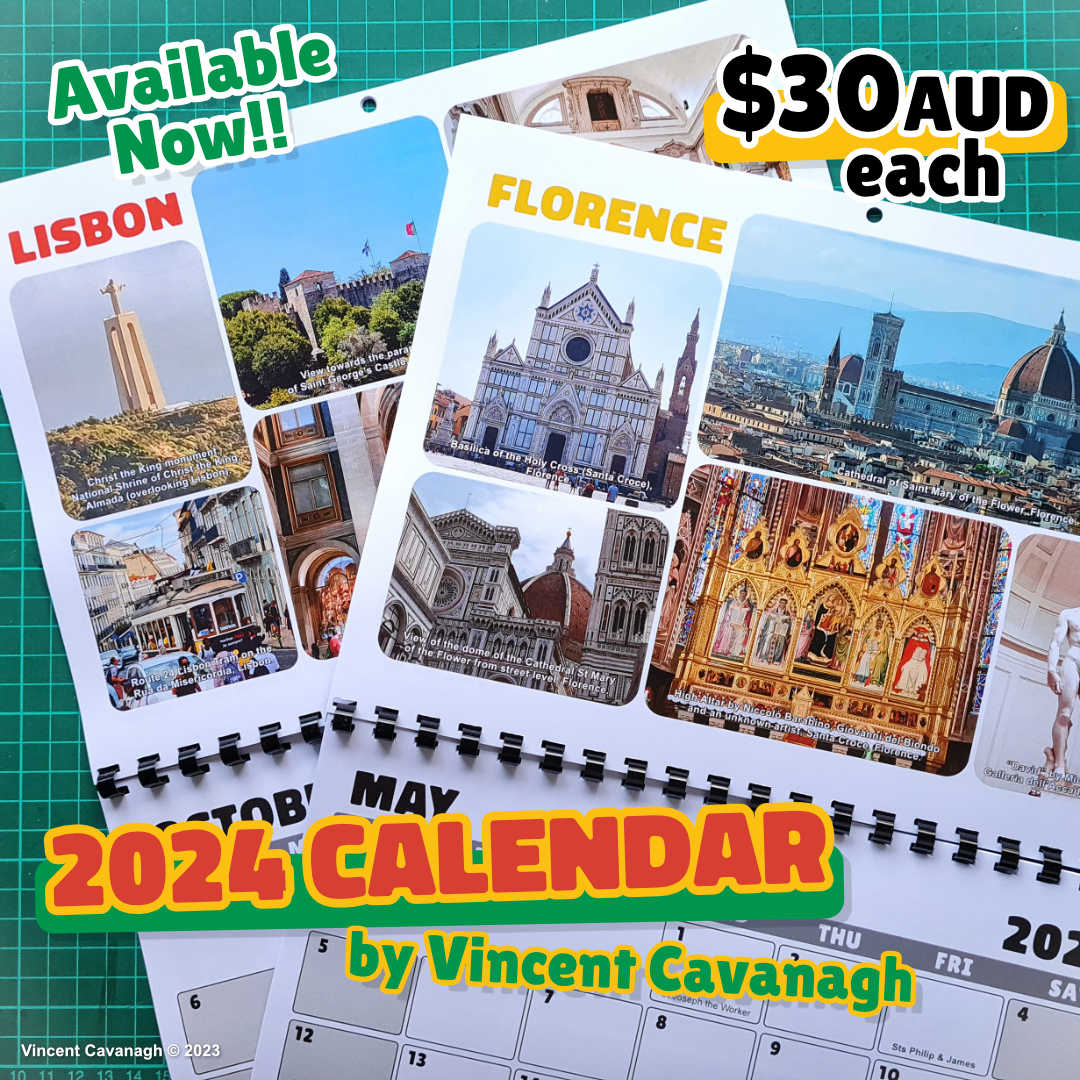
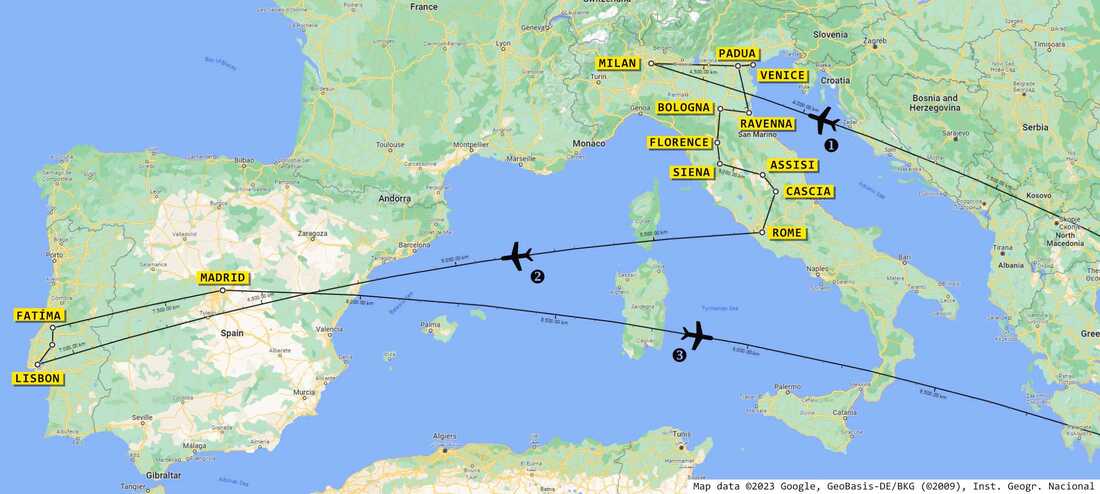
— Cost for the 2024 Calendars is $30 AUD, plus postage (within Australia). — For International postal orders we will arrange Air Mail costs appropriately, on an order by order basis. You can place your order through the form found under the Contact page or by messaging me via Facebook, or via LinkedIn (though I am hardly ever on that, at all). Vincent Cavanagh 29 Sept 2023 On our final afternoon and evening in Fátima we had a group session followed by Mass and then our last group session. These big group sessions, which contained some small group conversations, were designed to help us begin the internal processing of all that we had received on pilgrimage, before we return to our regular lives at home. After that all 4 bus groups gathered for a final dinner together. From here on we go in four different directions: some go back to Lisbon and catch homeward bound flights from there; some go by coach to Paris and catch homeward bound flights from there; some go by coach to Madrid and catch homeward bound flights from there; and some adult pilgrims continue to explore Europe with family and friends before coming home. This lovely statue caught my eye. It stands behind the reception desk at the Consolata Hotel in Fátima. Of course, everyone wanted the evening to last as long as possible before we went our separate ways. So the Green Bus members decided after that final dinner there was a necessity to go looking for gelato. Thankfully I got to this landmark before the rest of the gelato-seekers arrived. Getting a photo of it without pilgrims draped all over it is a bit of a win. If you look carefully through the pilgrim bodies, you can make out the contours of that landmark. Because our coach to Madrid wasn’t leaving until 9.30am, there was time for Morning Prayer and some silent prayer in the smaller of the two Consolata Hotel chapels. After studying maps before leaving home, it looked like we’d be coming into Madrid via Toledo. But to my surprise we actually came into Madrid via Salamanca. Perhaps the bus and truck fuel and food facilities on that route were better, because they were sure crowded. On the map the red marker is Fatima, the blue circle is our coach about to cross the Portugal-Spain border, and Madrid is like one of those places that all roads lead to. It was a 10-hour journey. Vincent Cavanagh #bbwyd #wydlisbon #wyd2023 #lisboa2023 15 Aug 2023, 10.58pm Sydney Meet Claudia. She took us for tours through both the basilicas and through the grounds of the Sanctuary of Fátima on the morning of 9 Aug. This is the largest piece of the Berlin Wall outside of Germany. It was bought by a Portuguese man who offered it to the Sanctuary of Fátima not long after the Berlin Wall came down in 1989. From 13 Aug 1961 until 9 Nov 1989 a large concrete wall separated West Germany and West Berlin from East Germany and East Berlin, with security checkpoints for those passing from western to communist sides and vice versa. On 12 May 1991, St Pope John Paul II visited Fatima, and his words during that visit have been engraved on a plaque near this portion of the Berlin Wall. A rough translation goes like this: Thank you, Heavenly Shepherdess, for having with maternal affection provided this liberation. We paused in front of this large crucifix by a German sculptor, where our bishop gave us a short talk on the differences between Religious Monumental Art – of which this crucifix is an example – and Religious Devotional Art – such as the paintings just viewed in the Basilica of Our Lady of the Rosary. At first this crucifix is a bit confronting because of how stark and simplistic it is. However its scale is in proportion to the new basilica, and it can be seen from just about everywhere in the Fátima sanctuary precinct, so after a while your heart softens towards it and grows in appreciation of this artwork. In a kneeling pose, looking towards the Basilica of Our Lady of the Rosary, is this statue of Pope St Paul VI. There are other statues of deceased popes who held the keys of St Peter from 1917 to the present era placed throughout the Fatima Sanctuary precinct, all of them looking intently towards the old basilica. Notably Pope Benedict XVI’s statue is not yet present, but there’s a spot marked out for whenever his statue is completed. There is an area in Fátima for lighting wax candles, and it seems like ‘the bigger the better’ is quite normal. Once upon a time it used to be a tradition in Portugal to make an offering of your body weight in wax. Now it is more normal to offer wax candles approximating your body height. That’s perhaps why the man in the photo is carrying such tall candles. Close by the Chapel of the Apparitions is this large oak tree. It is over a hundred years old. It marks the place where the three children would wait and pray the rosary prior to each of the 13th of the month apparitions of Mary, mother of Jesus. While it isn’t the holm oak tree upon which Mary stood, it is still a physical witness to the events of May 1917 to Oct 1917. Edited excerpts from the Sanctuary of Fátima website blog, 6 Feb 2007: This tree has been designated a tree of public interest by the Portuguese government. Before that designation in 2007 happened, the tree was in danger of dying because so many pilgrims took snippets off it. Now it is protected by a circular wall 100 metres in diameter. During the day there were just too many pilgrims around this statue of Pope St John Paul II to get a good photo. So after dinner that night, I decided to walk to this location, and then it was possible to view his life-like statue clearly. Vincent Cavanagh #bbwyd #wydlisbon #wyd2023 #lisboa2023 10 Aug 2023, 7.12am Portugal | 10 Aug 2023, 4.12pm Sydney On Wednesday, 9 Aug, we had a walking tour of the whole Fátima site. Part of that tour was exploring the Basilica of the Holy Trinity. We had been there for Mass the previous day. By 1973 the need for a much larger basilica than the Basilica of Our Lady of the Rosary was acknowledged. However the building of the Basilica of the Holy Trinity didn’t begin until 2004, almost 4 years after Francisco and Jacinta were beatified. The building itself wasn’t completed until late 2007, with most of the major artworks installed during 2008. Inside the Basilica around 8000 pilgrims can be seated, and there’s room on the altar-sanctuary to seat up to 100 clergy. From this photo you can see how vast the outdoor area between the two Basilicas. The whole area is used for night-time processions and for outdoor Masses at big events. You can also see how the Basilica of the Holy Trinity blends into the landscape and doesn’t detract from it. The exterior surface of the Basilica is made from locally sourced white stone. If you zoom into this photo a bit, you can better see the wall-covering mosaic and the seating for the clergy. Produced in the Vatican workshops, many international artists took part in this painstaking mosaic artwork. The photo also gives you an idea of just how many pews there are. In front of the group of Saints in the mosaic on the left-hand side of the altar is the Virgin Mary, with St Francisco and St Jacinta on either side of her, with possibly Lucia – without a halo, and garbed as a Carmelite nun – behind the Virgin Mary’s left shoulder. On the right-hand side of the altar, the leading figure of the mosaic Saints is St John the Baptist. For those of you familiar with the Catholic Mass, and Eucharistic Prayer No. 1, two groups of Saints are mentioned: the first group before the consecration is headed by the Virgin Mary, and the second group after the consecration is headed by St John the Baptist. At the far right-hand end of the mosaic, after this glorious depiction of the gathered Saints in heaven around the Lamb of God, there is a reminder that Hell, too, exists. Surrounding the big circular church interior of the Basilica is this wide underground walkway. There are 12 exits from the church interior into this walkway, one for each Apostle. Then you find all kinds of chapels, toilet facilities, meeting rooms, exhibition spaces, and sets of stairs opening out from this walkway. It was also a great place for those special moments of seeing familiar faces in unexpected places. One of those chapels off the walkway is this Blessed Sacrament chapel, which can fit up to 200 pilgrims for adoration and prayer. In the centre of that golden square shape is a simple circular monstrance holding a consecrated host for veneration. Spending time before a consecrated host visible in a monstrance is called adoration: because Catholics believe in the consecrated host Jesus Himself is truly and fully present. In the exhibition space, there was a temporary exhibition on the Rosary. It will remain there until late 2024, when a new temporary exhibition will take its place. Gathered in this exhibition were many rosary beads used by popes, and saints. St Padre Pio’s rosary beads were there. There were some art installations, but they didn’t capture my attention, and artworks. This set of rosary beads belonged to one of the Marto children, either to St Francisco or to St Jacinta. The beads and crucifix are made of bone; and strung with string or twine. In the exhibition, this painting did capture my attention. It was painted by Simon Rodrigues in the year 1605; and it is called either ‘Adoration of the Shepherds’ or ‘Shepherds Worshipping’. He was a Portuguese artist who died in 1629. For the colours to still be so vibrant after over 400 years is amazing. These are the main entry and exit doors to the Basilica of the Holy Trinity. It has been designed so that when you come out, there is a direct line of sight to the Basilica of Our Lady of the Rosary. Vincent Cavanagh #bbwyd #wydlisbon #wyd2023 #lisboa2023 9 Aug 2023, 1.08pm Portugal | 9 Aug 2023, 10.08pm Sydney The tour we did of the basilica of Our Lady of the Rosary on 9 Aug was part of a much wider tour of the whole sanctuary precinct. The other two parts can be broken up into the Basilica of the of the Holy Trinity and the memorabilia around the grounds of the Sanctuary. The construction of this basilica began on 13 May 1928, only 11 years after the apparitions began and two years before official papal recognition of the apparitions as ‘worthy of belief’. What this phrase means is that firstly nothing has been found within the apparition narrative that is contrary to the Gospel, and secondly that everyone is invited to take it seriously while at the same time there is no compulsion to do so – in effect, if it helps you run with it, if it doesn’t help you then you can ignore it without peril. Such a papal declaration only happens after extensive study: of the messages received; of the accounts of the events; of the lives of the seers; and of the spiritual fruit produced; all interspersed with rigorous debate; and is never given lightly. The colonnades on both sides of the basilica of Our Lady of the Rosary resemble the colonnades at St Peter’s Basilica in Rome in that they give pilgrims a sense of being gathered together in love. The statue of Our Lady in the niche of the bell tower was donated by the United States of America in 1958. In the monogram above the statue you can see three intertwined letters, N, S and R. They stand for ‘Nossa Senhora do Rosario’: in English, Our Lady of the Rosary. The crown beneath the cross that tops the bell tower was designed to be seen from the nearby freeway: tall enough and big enough to be seen from a considerable distance away. The external altar area with the all-weather canopy is called ‘Altar do Mundo’ or Altar of the World. Why? Because it makes very large open-air celebrations of Mass possible when it seems like all the world comes to visit. It is particularly necessary in the warmer months from April to November when very large crowds come on the first Saturday of the month and on the 13th of the month, and whenever the pope visits. The writing you can see upon that golden arch, ‘Regina Sacratissimi Rosarii Fatimae Ora Pro Nobis’ in Latin, means in English: 'Queen of the Most Holy Rosary of Fátima Pray For Us'. But it isn’t painted on, it’s a mosaic, and it was made in the Vatican workshops and donated by the Catholics of Singapore. It has been painted; and has been painted right onto the wall. In it our Lady of Fátima, full of light and peace, is inclined towards the three children. To her left is a depiction of the annunciation. To her right are several bishops or popes deliberating with the dome of St Peter’s Basilica in the background. In the foreground is the Angel of Peace ministering the Eucharist to the three children. Behind the children is a depiction of an unidentified Pope, in a protective pose. In this photo you can see one of the two upper balconies, it’s the one on the right-hand side. With both balconies and the generously sized nave, up to 1500 pilgrims can be accommodated for the celebration of Mass. Consider how Fátima is on the opposite side of the world to the Broken Bay diocese. Then consider that the parish of The Entrance is named Our Lady of the Rosary, the parish of Wyoming is named Our Lady of the Rosary, the church at Killara is named Immaculate Heart of Mary, and the cathedral at Waitara-Hornsby is named Our Lady of the Rosary – and you begin to glimpse the worldwide impact of Fátima. Vincent Cavanagh #bbwyd #wydlisbon #wyd2023 #lisboa2023 9 Aug 2023, 12.39am Portugal | 9 Aug 2023, 9.39pm Sydney Map of our tour route It is also called the Caminho dos Pastorinhos or Way of the Shepherds. But it certainly isn’t a walk on flat ground, the first part is hiking up a long climbing hill. How we see Fátima now is not how it was in 1917. The village was in the map areas of #2, #3 and #4, and where the Shrine is now was just pastureland for the sheep. Start of the Via Crucis, First Station Via Crucis is Latin for Way of the Cross, and this starting point is map area #1. In this First Station of the Cross, Jesus is sentenced to death. What you can’t see from this angle of photo is Pontius Pilate washing his hands. Each of the Stations is housed in one of these concrete hut-like structures to protect them from the weather, and you have to walk a good distance between each one. On either side of the path are olive groves. Site of 19 August 1917 apparition The monument to this apparition of Mary, mother of Jesus, is located between the 8th and 9th Stations of the Cross: 8. Jesus speaks to the women of Jerusalem, 9. Jesus falls the third time under the Cross. Before the 13 August, when the next apparition in the series was due to happen, government authorities kidnapped the children and held them hostage to prevent the 13 August apparition. But when the children were finally released, and all was back to normal, Our Lady appeared to them here - within a short walk of their village - instead of at the usual meeting place in the Cova da Iria. At this time Mary, mother of Jesus, gave them this message “Pray, pray very much, and make sacrifices for sinners; for many souls go to hell, because there are none to sacrifice themselves and to pray for them.” End of the Via Crucis and its chapel After the 14 Stations of the Cross, pilgrims come to this chapel next [Chapel of St Stephen of Hungary]. Above is the life size depiction of the Crucifixion scene, and below is a chapel where Mass can be celebrated. The funds for these Stations of the Cross were donated by Hungarian refugees after the 1956 uprising in Hungary; and were built during the 1960s. This chapel is dedicated to St Stephen, the holy king of Hungary, and opened in 1992 in thanksgiving for the liberation of Hungary from communism. From St Stephen’s kingship onwards, no earthly lady was ever to be called queen since he had declared Mary, mother of Jesus, Queen of Hungary. We had a group photo taken here in front of the chapel. Interior of chapel, and altar Possibly the Saints depicted in the stained glass are St Elizabeth of Hungary, St Emeric son of St Stephen, St Stephen himself, and St Adalbert the bishop who baptised St Stephen. Although the female Saint could also be Blessed Gisele, St Stephen’s wife. [Editor's Note: on closer inspection of the original photograph, the left most saint is St Stephen's wife Blessed Gisele and the right most is in fact St Gerard of Csanárd (Hungary), not St Adalbert – St Adalbert himself does have a stained glass window, but it is elsewhere in the chapel. So the correct line-up of saints behind the altar, from left to right, is as follows: Blessed Gisele (Hungarian: Gizella); St Emeric (Szent Imre); St Stephen (Szent István); and St Gerard (Szent Gellért).] Roof of Chapel It had this magnificent mosaic on the ceiling. Site of two of the apparitions of the Angel of Peace In the year or so before the 13th of the month apparitions started in May 1917, the three children were visited by the same angel three times. The angel identified himself both as the Angel of Peace and as the Angel Guardian of Portugal, and he also taught them prayers to pray. Here the first and third angel apparition happened; the second occurred near the village well. In Portugal during the 14th to the 17th centuries, devotion to the Angel Guardian of Portugal was high, and there was even a national feast day in the liturgical calendar to honour the Angel. But by World War I, devotion had all but disappeared. From 1952 onwards that national feast day has been reinstated, largely due to these apparitions of the Angel. Lucia’s family home Tired and hot from the climb up the hill of the Stations of the Cross, I ended up near the rear of the back half of our four buses’ worth of pilgrims by the time we got to Lucia’s home. Because everything was so cramped, I only really saw the outside of these village dwellings and not the inside. Lucia’s family barn and stables If you recall the Fátima movie released in 2020, some of those village scenes must have been filmed in this exact location. Jacinta and Francisco’s home These two were siblings, and Lucia was their cousin. We didn’t get anywhere near the well, because a large contingent of American pilgrims were gathered around it. They had either just finished Mass or just finished praying the Rosary there. This was a place where the children often prayed together and played together. Monument to the three children This monument is placed near a roundabout, and the statues of the children are placed so that it looks like they are walking towards the Shrine. This was my view from the bus on the way back to the hotel. It’s far more effective than a ‘This way to Fátima’ sign. Vincent Cavanagh #bbwyd #wydlisbon #wyd2023 #lisboa2023 10 Aug 2023, 11.48am Portugal | 10 Aug 2023, 8.48pm Sydney Thankfully we didn’t have to start travelling the same day as the Closing Mass. The next morning (7 Aug) we did a bit of a debrief in our small groups over morning tea, and then waited for our coaches to arrive for a noon departure. On arrival in Fátima, we settled into our rooms at the Consolata Hotel. This Hotel has two chapels of its own, one for single bus or smaller, and one that fitted our 4-bus group. In that bigger chapel we had our first Mass in Fátima. The Fatima story – in brief: On 13 May 1917 as World War I was progressing, to three shepherd children Lucia, Francisco and Jacinta, Mary the mother of Jesus appeared and promised to return on the 13th of each month until 13 October 1917 in Fátima when a great miracle for all to see would happen. As the months progressed Mary taught the children about heaven, hell, and purgatory, about the need for reparation for sin and the need for sacrifices to be offered to obtain the conversion of souls, and her desire for the Rosary to be prayed to end the War. On 13 October a massive crowd gathered in muddy and wet conditions, and they all witnessed the miracle of the sun. Even those from miles around who didn’t go to the apparition site. Newspapers of the time reported on this event. The sun began to spin, give off many colours, and hurtle dangerously close to the earth before resuming its normal position and appearance. In 1930 the Church declared this series of apparitions to be worthy of belief. Jacinta and Francisco have been canonised, and Lucia’s life has passed the test of heroic virtue and may now be called Venerable. Prior to these events in 1917, the same three children received visitations from the Angel of Peace and were taught two prayers, a prayer seeking pardon for others and a prayer of reparation for sin. Back to our pilgrimage The first thing we did on Tuesday (8 Aug) was to get back on our buses and visit where the three children of Fátima lived, and the other apparition sites. – But that deserves a write-up all on its own. On our return, we went to Mass at the new basilica. This photo was taken towards the end of that Mass on a 10 x zoom setting. On the far left you can see Archbishop Fisher. This basilica can hold up to 8000 pilgrims. Because we were in Europe we celebrated the memorial of St Dominic, founder of the Dominican order. Archbishop Fisher being himself a Dominican, is probably why he was a visible concelebrant. If we had been in Australia, we would have celebrated St Mary of the Cross McKillop instead, and St Dominic on 3 August. We had a mix of at least 3 different language groups at this Mass which was presided over by a Portuguese prelate. After Mass we went in search of lunch, and then had a relatively brief unstructured time until 3.30pm. Then we met in small groups for journaling and collective reflecting upon our experiences since 21 July. After dinner we prepared to join in the night-time procession. The concept of a procession like this might be difficult for some people to get their heads around. It’s like this. If God permitted Mary to visit us, and to bring God’s messages to us, then it is only proper to express gratitude. The number of people cured of illness during the apparition timeline reminds us that asking Mary to intercede for us before God is a good idea. It isn’t easy to leave a warm hotel to go to a late-night procession, so that’s a penitential element. In this procession all three things are combined: gratitude, intercession and penance. It begins at the main site of the apparitions, which is partly undercover and partly open to the very large, concreted precinct. Here we began by praying the Rosary at 9.30pm. But only one half of one decade of that Rosary was in English. The simplest explanation of the Rosary is that it consists of 5 lots of One Our Father 10 Hail Mary’s and One Glory Be prayers with beginning and ending prayers, and during each decade – or set of 10 Hail Mary’s – you think about an event in the life of Jesus, with either Joyful, Luminous, Sorrowful or Glorious themes. Then the candlelight procession began. The Cross leads the procession, then the priests, then the pilgrims who carry the statue of Our Lady of Fátima, then the pilgrims who prayed the Rosary at the chapel of the apparitions, and everyone else falls in behind. While we walk there is silence interspersed with the Rosary in many languages at once, or with singing the Fatima hymn which everyone can join in the chorus, ‘Ave, Ave, Ave Maria, Ave, Ave, Ave Maria’. As the procession begins to return to the chapel of apparitions, an honour guard appears, with each selected person holding a flag from a different nation. When the procession concluded we made our way back to the hotel, in hope of a good night’s sleep prior to our second and last full day in Fátima. Vincent Cavanagh #bbwyd #wydlisbon #wyd2023 #lisboa2023 8 Aug 2023, 11.12pm Portugal | 9 Aug 2023, 8.12am Sydney It is traditional that the location of the next WYD is announced at the end of the Mass with the Pope at the Vigil location. And the next World Youth Day is… …in Seoul, South Korea in 2027. Not earlier because there will be a Jubilee Year gathering of young people in Rome during 2025. So much for my mother’s hopes of an English-speaking, southern-hemisphere location like New Zealand or even Melbourne. But at least the time difference from Seoul to Sydney is only an hour. These concrete arches are part of the transport hub of Oriente Station (buses specifically, in the photo above), which providentially was within walking distance south of the Vigil site – and even more providentially took us back to within walking distance of our hotel. The transport hub at Oriente Station has taxis, buses, metro, local trains and regional trains. Because it was crowded, we had to wait to get in. On a very hot day, do pilgrims take their gear and sleeping bags to the hotel first? Not if a McDonald's is on your route. Ice cream first!! Then after all the bagels for the meals of the previous 24 hours, comfort food was in order. This is what a burger meal from Lisbon, Portugal looks like. Compared to the burger buns we get at home, this bun was nicer. Only then, after having cooled down and refuelled, did we head for our hotel rooms – for showers and to try and catch some sleep after not getting much the night before at the Vigil site. The huge stage at Edward VII Park is now under deconstruction, and that’s sad to see because it is a visible sign that World Youth Day Lisbon is over. Despite the crowds, despite the heat, despite all the other inconveniences, it was still a taste of what Heaven’s joy and peaceful unity in diversity will be like. The lyrics from the WYD Sydney theme song continue to hold true: “Every nation, every tribe, come together to worship You. In Your presence we delight, we will follow to the ends of the earth.” Vincent Cavanagh #bbwyd #wydlisbon #wyd2023 #lisboa2023 6 Aug 2023, 1.04pm Portugal | 6 Aug 2023, 10.04pm Sydney |
News and Other StuffAbout recent artwork, inspirations and other things I find interesting. Archives
June 2026
Categories
All
|
RSS Feed